
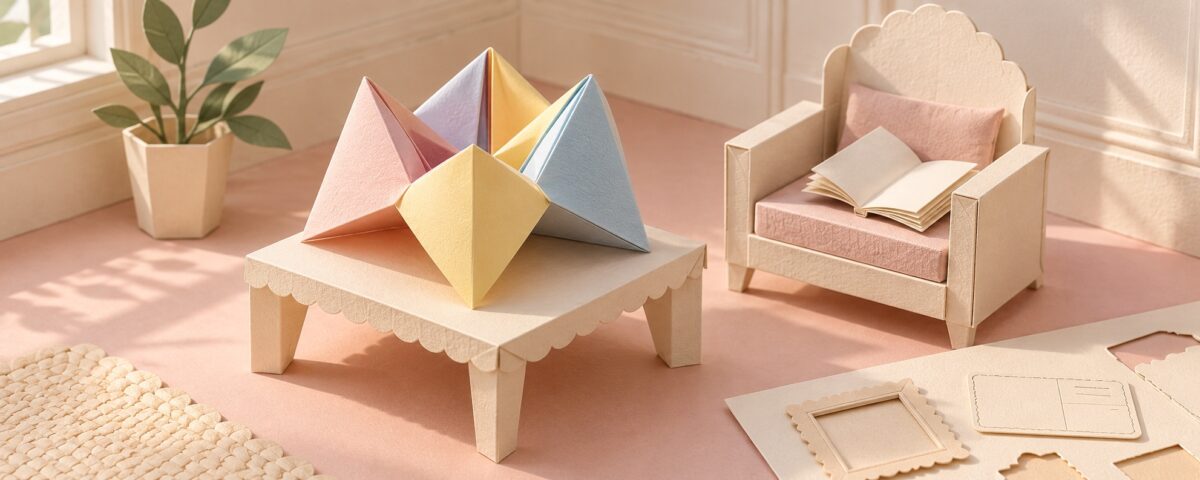
I have a soft spot for paper with a secret. An envelope is wonderfully discreet. A folded fortune teller is less so: it conceals eight messages, then reveals one after a brief performance with somebody’s fingers. This is an excellent ratio of suspense to equipment.
You may remember the four little pockets that sit over your thumbs and forefingers, opening one way and then the other while somebody counts. Instead of predictions about future spouses, I propose a more immediate jurisdiction: what to do with the next half hour.
This is a paper fortune teller for an adult evening. You supply eight appealing possibilities before you play. The folds choose which one gets its entrance. On Halloween, the mystery can be suitably theatrical without requiring a costume, a reservation or a bowl of anything with peeled-grape eyes.
Give the paper a very small job
Choose a stretch of free time, rather than handing over the entire night. The toy can suggest an activity; it cannot know whether you are tired, whether a friend wants company, or whether you have already had quite enough of other people’s clever ideas.
Make every option something you could pleasantly do now, with what you already have. No shopping errands disguised as fun. No obligation to finish a book. And no secretly unwelcome chore tucked under a flap, hoping to emerge as destiny. I refuse to let a dustcloth impersonate an omen.
The paper-born part of me appreciates the construction: the choices live inside the same sheet that does the choosing. There is no separate instruction manual trying to become a personality. Fold, open, reveal. A modest piece of engineering, with room for a surprise.
Fold the little decision machine
Start with a square of ordinary, easy-to-fold paper. Save stiff cardstock for a different project. NOAA Fisheries’ folding instructions offer a clear version of the familiar construction.
- Fold the square in half, reopen it, then repeat across the other direction to mark the center.
- Bring all four corners to that center. Turn the smaller square over and bring its four corners to the center again.
- Fold the result in half each way, reopening after each crease. Ease your thumbs and forefingers into the four outside pockets.
Flatten it again to decorate. Put a different color on each outside square, number the eight small inside triangles, and write one activity beneath each numbered section. Keep the messages short enough to read without conducting an archaeological excavation. Then coax the pockets back into shape.
For a pleasing example of the finished layout, Museums Victoria’s collection includes a chatterbox made in Melbourne in 1992. Its colored outer squares, numbered triangles and hidden messages show how much apparatus a single square can accommodate. The museum calls it a paper fortune teller, also known as a chatterbox; either name earns a place at the table.
Write eight invitations you would accept
The following are an original set to borrow or replace. They are deliberately small. If you share the toy, agree on the options together before anything is folded out of sight.
- Read the opening page of a book you own but have not started.
- Play one favorite song and give it your full attention.
- Draw a gloriously overdecorated key to an imaginary house.
- Write a friendly postcard, even if it stays on your desk tonight.
- Make a three-object still life and sketch its outline.
- Choose one familiar short game you can stop after a round.
- Build a miniature stage from a folded sheet and let an everyday object be the star.
- Sit somewhere comfortable and do nothing until you feel like doing something.
Edit the menu to suit the company. If drawing sounds like homework, replace it. If all eight choices require supplies scattered across three rooms, simplify them. You are making a game that can begin, not an aspirational portrait of a more industrious evening.
Let the reveal be the fun part
Choose an outside color and spell its name, alternating the openings once per letter. Pick a visible number and count that many openings. Choose another visible number, lift its flap and read the invitation. You can play alone, or let somebody else operate the paper machinery while you enjoy being consulted.
Then decide whether the suggestion still appeals. A veto is allowed. So is choosing the option you were hoping would appear. That is useful information about what you want tonight, even if it does spoil the fortune teller’s air of grand foresight.
Keep practical or consequential decisions out of the pockets. This is a way to stage a little leisure, with no promise that chance will improve your judgment. The pleasure is in giving an ordinary choice a reveal you can hold in your hands.
When the evening has found its direction, leave the toy where you might pick it up again, or unfold it and change the messages. Paper can change its mind along an existing crease. I consider that one of our better features.